Invoices, werkbonnen, materials, schedules: the coordination that lives in Word files, chat threads and one person's memory. We build the system that holds it, with an assistant that prepares the admin.
A Dutch contractor runs invoices, materials and his assistant from his phone. A university department plans its whole teaching year in one system.
Screens show demo data. Real records stay private.
One system. Three ways in.
Most firms buy an app, a back office and an AI tool from three vendors, then glue them together with people. We build the three as one: every screen and every answer comes from the same records.
Demo data
In the field: the app
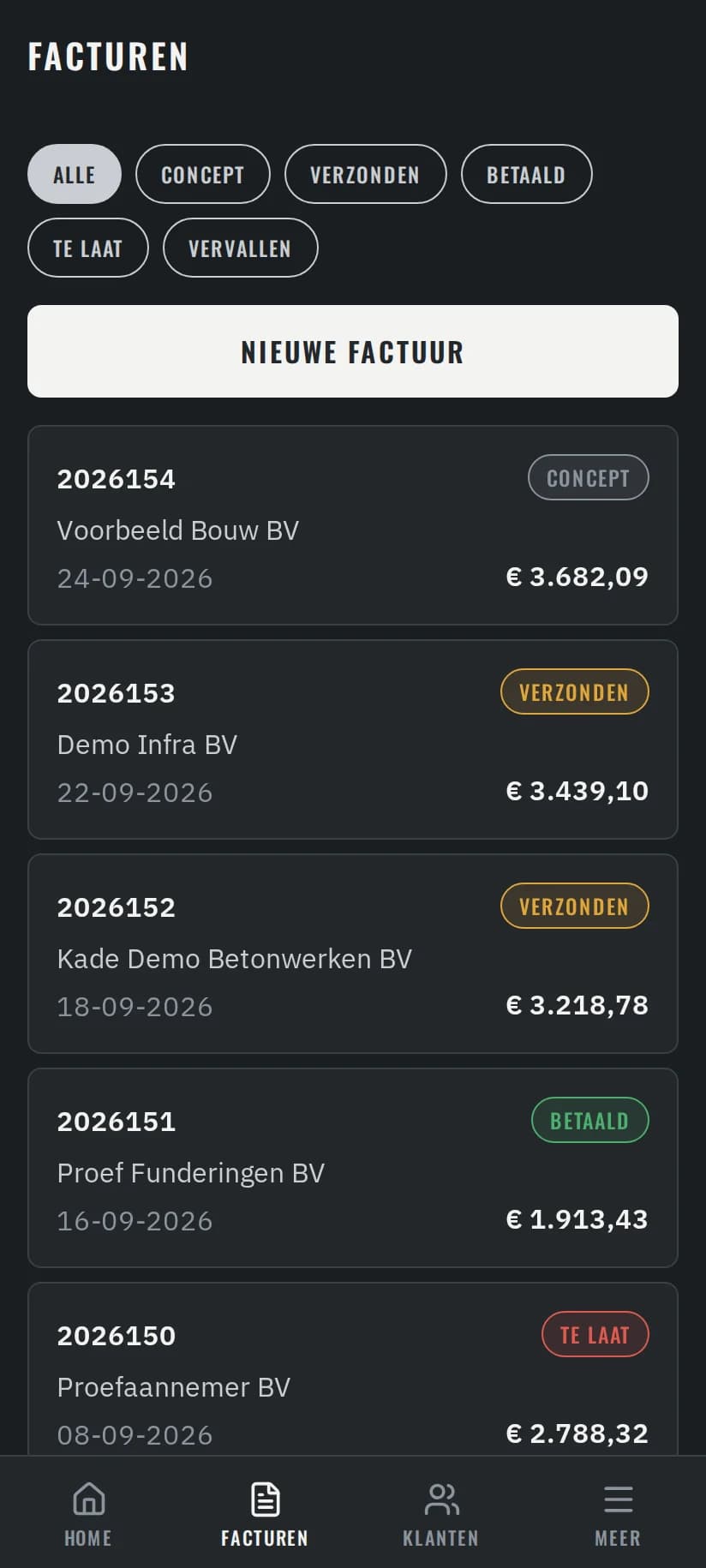
On the phone at the site or in the browser at the desk, built around your own unit of work: the werkbon, the order, the batch, the case.
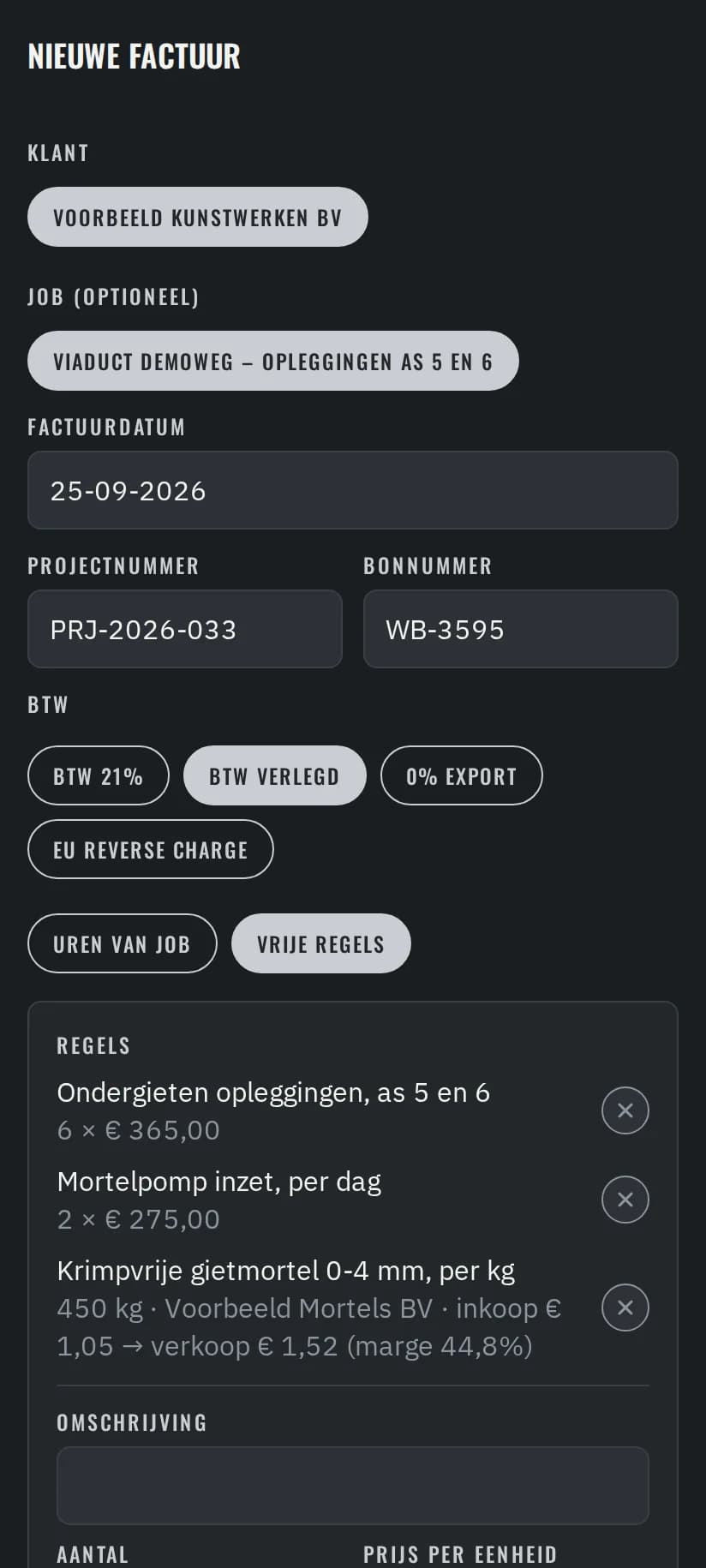
Bajgora: a new invoice that carries the client's project and werkbon number.
Demo data
At the desk: the system
Records, documents and numbers in one place: the PDF for the client, the export for the accountant, a live view of what is open, late or waiting on someone.
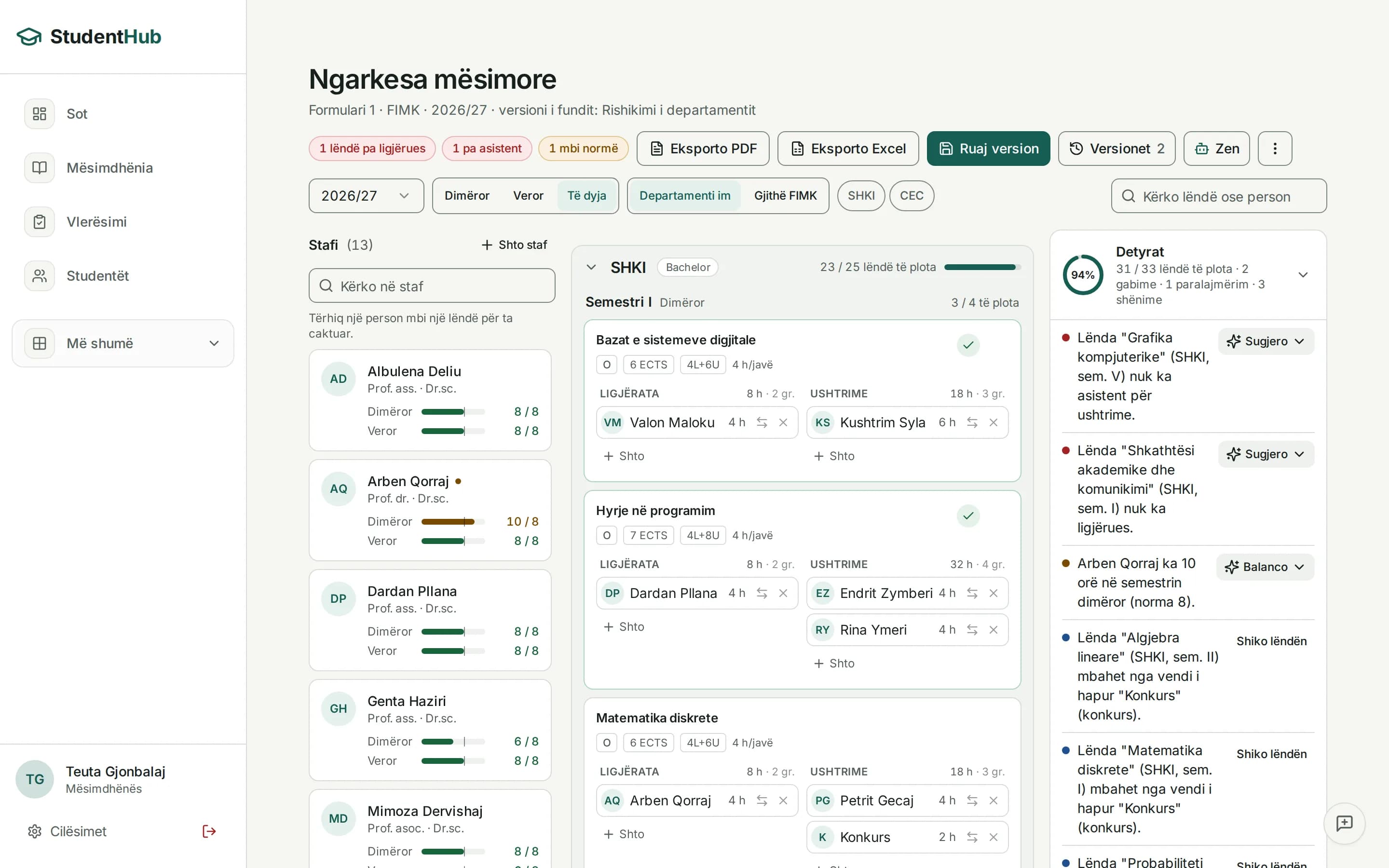
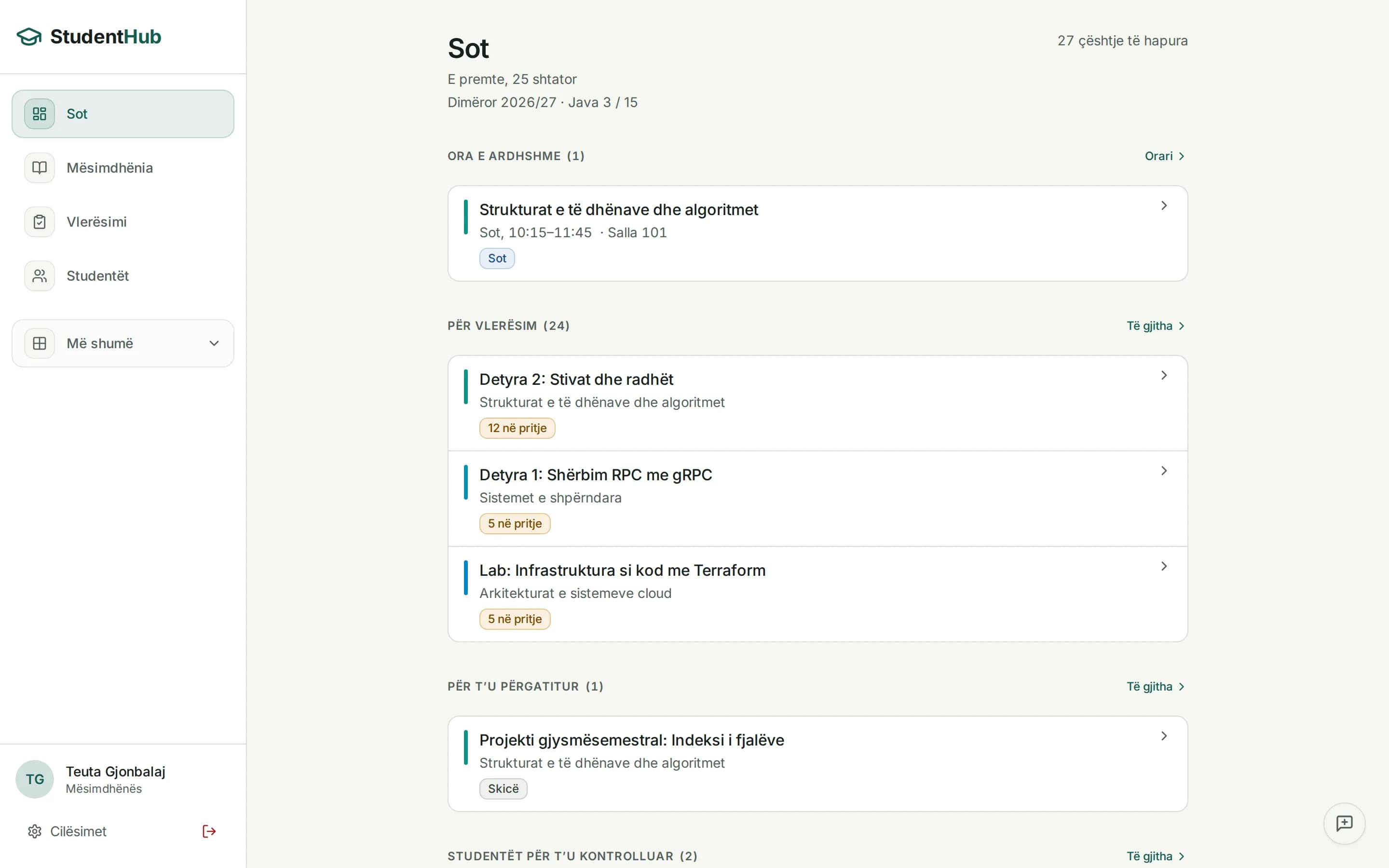
Student Hub: who teaches what, for which group, with every hour accounted for.
Demo conversation
WAssistant
You: Which invoices from De Vries are still open?
Assistant: Two: 2026-112 (€ 4.180, due in 6 days) and 2026-097 (€ 2.950, 9 days late).
You: Send me the PDF of 097.
Assistant: Here it is: 2026-097, De Vries Infra, werkbon 4471.
You: From now on put our KvK number in the footer.
Assistant: I'll note that as a change for the next update. Klopt?
In the chat: the assistant
Ask it in plain words and it answers from your own records. It drafts, reminds and files the small requests, and it asks before it changes anything.
Bajgora: the assistant in Telegram asks “klopt?” before it writes.
How an automation is made
Every automation we build has the same shape: something arrives, the system reads and checks it, a person confirms, and the result lands where it is needed. Here is the next one we are building into the Bajgora system.
Werkbonkopie
Project 21-0457
Bon 4471
6 h pompen
12 × voegmortel
Paraaf uitvoerder
Factuur 2026-118concept
Project 21-0457 · bon 4471
6 h pompwerk
12 × voegmortel
Btw verlegd
wacht op “klopt”
A werkbon becomes an invoice
1
It arrives
The client's werkbon comes in as a PDF in the mail or a photo from the site.
Nobody retypes it.
2
It is read
Project number, bon number, hours and materials are taken off the page.
Nothing to do yet.
3
It is checked
Matched to the project, priced from the supplier lists, the VAT rule applied. Anything unclear goes on a short list.
Only the unclear cases need a look.
4
A person confirms
The draft invoice waits on the phone, every line traceable to the bon.
One look, one tap: klopt.
5
It lands
PDF to the client, a copy for the accountant, the overview updated.
The money side is current the same day.
How we build it with you
Walk one real case
One conversation, following a single job from the first message to the paid invoice. Where the hours go becomes visible.
Model what is true
Projects, bons, materials, people, deadlines: the records everything else reads from, named the way your company names them.
Build the three surfaces
The app, the system and the assistant on those records. You follow every step on a live progress page and decide on review pages, not in mail threads.
Run it together
Two weeks in your real work, adjusting what the work shows. Then it is yours, and Care keeps it running.
What changes in the company
Before
After
Typed twice, in two places
Typed once, where the work happens
Invoices at the end of the month
Invoices the day the work is signed
“Ask Marieke, she knows”
Everyone sees the same state
Calling the office for a number
Asking the assistant
Automations worth building
A starting list from the work we know. Each one follows the same shape: the system does the routine part, and a person makes the call.
Construction and installation
Automation
When
The system
A person
Werkbon to invoiceA signed werkbon comes in: the system drafts the invoice with project, bon, hours and materials, and a person confirms with one tap.
A signed werkbon comes in
drafts the invoice with project, bon, hours and materials
confirms with one tap
Daily site reportThe crew sends photos and a voice note: the system turns them into a dated report for the client, and a person adds a line and sends it.
The crew sends photos and a voice note
turns them into a dated report for the client
adds a line and sends it
Crews and hoursA crew arrives on site: the system books the hours to the project and fills the weekly overview, and a person approves the week for payroll.
A crew arrives on site
books the hours to the project and fills the weekly overview
approves the week for payroll
Production and materials
Automation
When
The system
A person
Orders into productionAn order arrives by e-mail or from the web shop: the system puts it in one queue and proposes the production batch, and a person plans the day.
An order arrives by e-mail or from the web shop
puts it in one queue and proposes the production batch
plans the day
Batch records and documentsA batch leaves the line: the system keeps recipe, lab result and batch number, and prepares the safety data sheet and certificate for each delivery, and a person signs off the batch.
A batch leaves the line
keeps recipe, lab result and batch number, and prepares the safety data sheet and certificate for each delivery
signs off the batch
Delivery to the installerMaterial is ready: the system links the delivery to the installer's project, so the crew knows what arrives when, and a person changes the date if the site is not ready.
Material is ready
links the delivery to the installer's project, so the crew knows what arrives when
changes the date if the site is not ready
Offices and advisory firms
Automation
When
The system
A person
Document intakeDocuments arrive through five channels: the system sorts, names and files them before anyone opens them, and a person handles only what it could not place.
Documents arrive through five channels
sorts, names and files them before anyone opens them
handles only what it could not place
Missing documentsA deadline approaches: the system reminds the client and shows who is late, and a person calls the two who never answer.
A deadline approaches
reminds the client and shows who is late
calls the two who never answer
Deadlines and handoversWork moves between people: the system keeps one calendar of what is due, for whom, by whom, and a person sees the week at a glance.
Work moves between people
keeps one calendar of what is due, for whom, by whom
sees the week at a glance
Your process is not on the list? Most are not. Describe it, and we tell you honestly whether it is worth automating. Request a 30-minute call
Where we work
Steuerkanzleien
Deutschland · auf Deutsch
Belege aus fünf Kanälen, manuell sortiert, bevor die eigentliche Arbeit beginnt. Wir bauen den Eingang vor DATEV.
A fixed price and a written scope before any work starts.
Weekly, visible progress, never months of silence.
People approve everything that matters; the software sorts, drafts and flags.
Your data under a processing agreement, with EU hosting.
An honest “not worth building” whenever that is the true answer.
What we don't
No custom build where a standard package fits. If one does, the Teardown says so.
No guaranteed ROI numbers. We measure before and after instead.
No ripping out systems that work, like DATEV or your accounting. We connect to them.
No published numbers we cannot verify, which is why some are described, not counted.
No lock-in: you own the code, the prompts and the documentation.
Built by an engineer who runs his own systems.
WuWei Labs is led by Agon Bajgora, a software engineer with more than ten years of experience and Head of the Computer Science & Engineering department at the University of Mitrovica “Isa Boletini”, where Student Hub runs the department's daily teaching operations. He holds an MSc in Informatics Engineering and is completing a PhD in AI on multi-agent systems at Ss. Cyril and Methodius University.
The name comes from the Taoist idea of Wu Wei, effortless action. The best systems don't demand attention; they flow. That is the standard: software that quietly does its job, people deciding what matters, and an honest “no” when a build is not the answer.
WuWei Labs is small by design. The person on the call is the person building the system. German-speaking firms talk to Sami Bajgora. Research, qualification and reporting run on our own AI operating system, so you can see how we automate ourselves before you pay us to automate you.
Three steps. Fixed prices. Written exclusions.
Every engagement starts small and earns the next step: one conversation, a written plan with a fixed price, a first working version in one to two weeks, and progress you can follow every week on a live progress page. Prices are public because you should not need a sales call to learn them.
A paid diagnostic of one real workflow: where the hours go, what to build first, what it costs, and what to leave alone. Credited in full against a pilot booked within 30 days.
The app, the office system and the assistant for a whole operation, with a native Android or iOS app where field work needs one. The Bajgora system is this step.
from €500 / month. After delivery: monitoring, fixes and steady iteration. Sold at the results review, never before delivery.
If the Teardown finds nothing worth building, you keep the report and we stop. If a pilot does not reach the go-live we agreed in writing, the second half is not due.
The ladder is public: the Workflow Teardown is €1,500 and is credited against a pilot. Pilots are €6,000–12,000. An operations system is €15,000–35,000. Care starts at €500 a month. You get a fixed quote in writing before anything starts.
Why not a standard package?
If a package fits your process, buy the package; the Teardown will tell you. We build when your process is what makes you different: a factory and an installer in one group, a price list nobody else has, crews who work in three languages.
How fast is a first working system?
A first working version usually exists in one to two weeks, and a production pilot in two to four, depending on integrations. The Bajgora app was on the owner's phone two weeks after the first conversation.
Do you replace our existing systems?
Only where the current tool is Word, paper or a spreadsheet. Systems that work, like DATEV or your accounting package, stay; we connect to them.
Does AI make decisions for us?
No. The assistant answers, drafts, sorts and flags. Anything regulated, financial or judgment-shaped goes to a person, and it asks before it writes anything.
How do you handle our data?
Under a processing agreement (Art. 28 GDPR), with EU hosting, and with §203-aware confidentiality for German professional firms. Deployment inside your own infrastructure is possible where that is the right call.
Where are you based, and in which languages do you work?
In Mitrovica, Kosovo, on Central European Time. Our systems in daily use are in the Netherlands and Kosovo. Builds are run in English; German-speaking firms work with Sami Bajgora, and Dutch-language questions are answered in Dutch.
What if our workflow isn't worth building for?
Then the Teardown report says exactly that, and we stop there. That honesty is what you pay for, and it costs less than finding out after a build.
Request a 30-minute call.
One process, one conversation. You get an honest view of whether it is worth building and what it would cost. If a call feels too soon, the Workflow Teardown (€1,500, five days, credited against a pilot) is the concrete first step.
Pick the days that suit you, and tell us about one process.
No spam. No sequence. A reply from Agon within one business day.